

If you read my previous post, you know how strongly I believe in the difference between talent and passion. We talked about how you don't need to be a born artist to let art protect your mind from daily work stress.
But even after agreeing with that, a quiet voice in your head might still be asking: "Okay, but how do I actually start if I can't even draw a straight line?"
It’s a completely natural question. Most of us haven't picked up a paintbrush since grade school, and the fear of making something "ugly" can paralyze you before you even begin.
Here is the secret that will completely change how you view a blank canvas: you are choosing the wrong era of art history to judge yourself by.
40+ Styles of Art: Why We Ignore the Academic Rules
Throughout history, there have been more than 40 major art movements.
For centuries, the world was dominated by Academic Art. This was the traditional, hyper-realistic style that required years of intense training, precise proportions, perfect shading, and undeniable technical talent. If you wanted to paint a portrait, it had to look exactly like a photograph.
No wonder so many people feel intimidated! If art therapy required Academic Art skills, almost none of us could use it to heal.
But at the turn of the 20th century, a massive revolution happened. A new wave of artists looked at all those strict rules and said: No more.
They intentionally rejected perfect details, realistic proportions, and rigid techniques. Instead, they shifted the entire focus of art toward two things: emotion and pure color.
The Green Stripe: Seeing with Emotion, Not Eyes
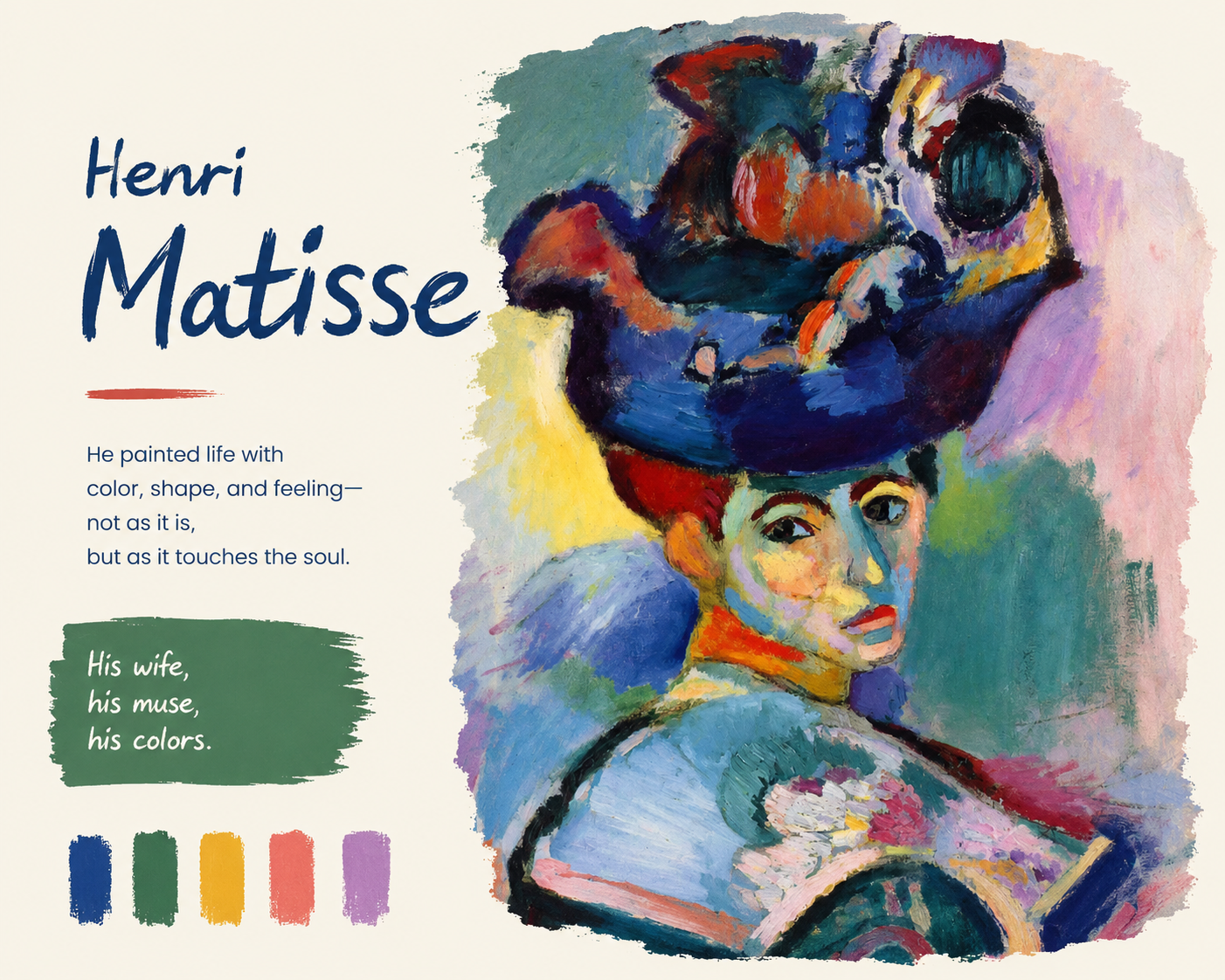
Take Henri Matisse, one of the giants of modern art, as the perfect example.
When Matisse painted a portrait of his wife, Amélie (famously titled The Green Line), he wasn't trying to create a realistic, photo-like portrait. He didn't care about getting her skin tone "correct" by traditional standards.
Instead, he painted a thick, bold stripe of bright green directly down the middle of her face to separate the warm and cool light in the room.
The art critics of his time were shocked, but Matisse was making a profound point: he wasn't painting how his wife looked to a camera; he was painting how he saw and felt her through color. He used bold, untamed colors to capture a mood, energy, and feeling rather than anatomical perfection.
This Is Exactly What We Do in Our Course
This 20th-century mindset shift is the heart of what we teach at Outlines Soul.
When you sit down after a brutal shift at work—after dealing with angry clients, demanding managers, or heavy pressure—you don't need the stress of trying to paint a realistic landscape. You don't need the pressure of Academic Art.
You need the freedom of modern art.
We take inspiration from modern masters like Matisse, teaching you step-by-step how to drop the rules and use simple shapes, textures, and color combinations to express what’s inside you.
-
You don't need to know how to draw faces.
-
You don't need to understand complex perspective.
-
You just need to let the color take the weight off your shoulders.
By shifting your goal from "making a realistic picture" to "releasing daily emotion," the fear of having no talent completely vanishes. The canvas stops being a test you might fail and becomes a safe sanctuary where you can finally unwind.
🎨 Ready to stop overthinking and start creating? Let me guide you step-by-step through simple, expressive modern art techniques designed for deep relaxation.
👉 Discover the Outlines Soul Course & Begin Your Journey Today
Until next time... please keep creating. 🤍
🌐 outlinessoul.com #OutlinesSoul #ArtAsALanguage #ArtTherapy #ModernArt #CreativeHealing #ExpressiveArt #HenriMatisse #Fauvism #NoTalentRequired #PleaseKeepCreating
Share:
Talent vs. Passion: Why You Don’t Need to Be an "Artist" to Defeat Work Stress
Destroying the 'Inner Critic': Why Mistakes in Modern Art Don't Exist
1 comment
I like simple Art more than Acadimic