Have you ever had a feeling so heavy, so tangled up inside your chest, that if someone asked you to explain it, you wouldn’t even know where to start?
We spend our whole lives trying to master alphabets, grammar, and spoken words. But the truth is, spoken language has a ceiling. When we hit trauma, deep stress, or fear, the verbal centers of our brain can quite literally shut down. We freeze.
That is where the language of art steps in. It is the ultimate global language, one we are born fluent in long before we ever learn to read or write. And for those who cannot speak up or speak loudly, a blank page becomes the only place on earth where their truth can finally be heard.
The Boy with the Big Hands: A Lesson from My Art Therapy Studies
During my journey earning my art therapy diploma, I came across a case study that completely changed how I look at a piece of paper. It involved a quiet little boy who rarely spoke. To look at him, you might just think he was naturally shy or introverted.
But then, he was given some markers and asked a simple question: "Can you draw your family?"
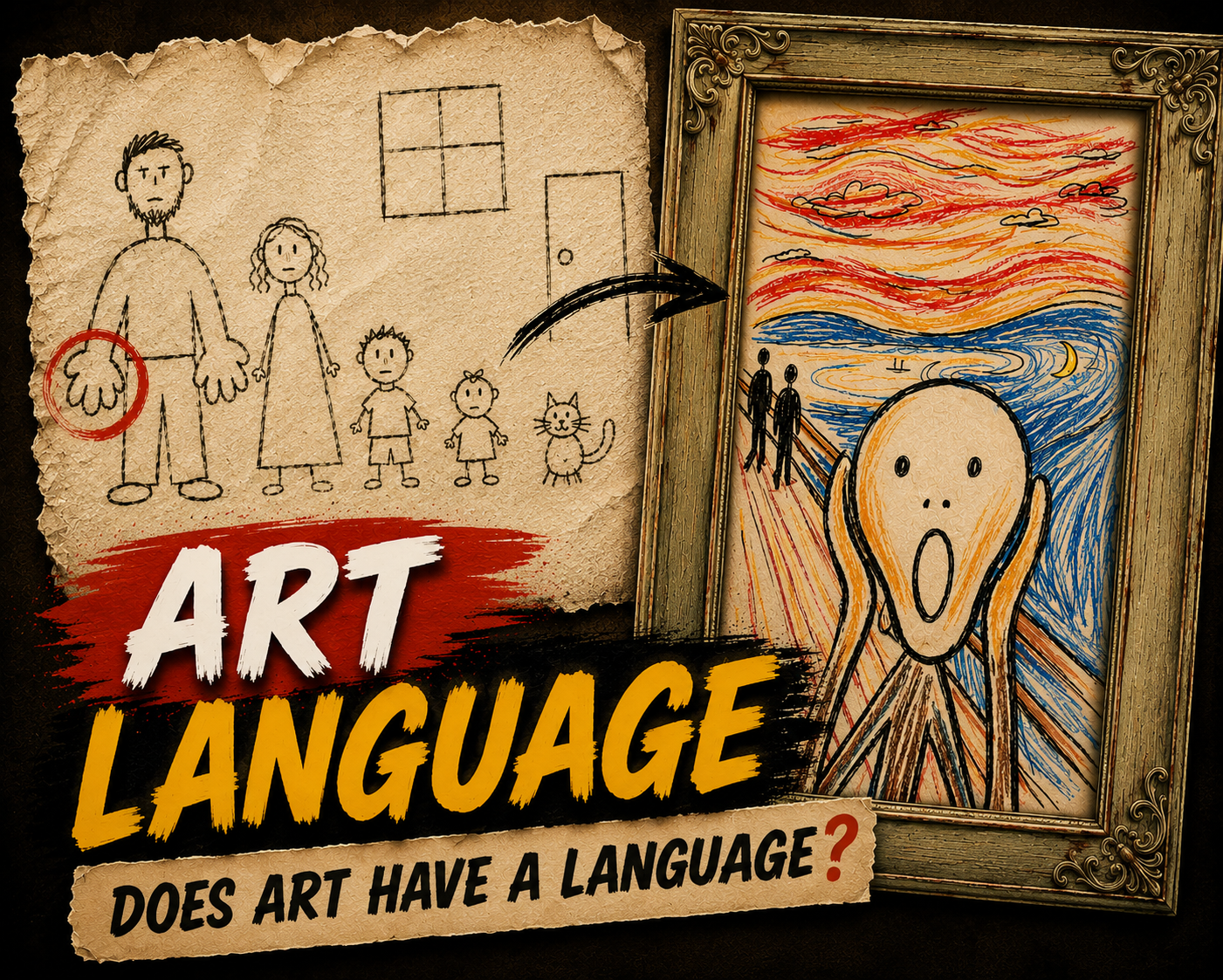
He sat down and drew his family members. Everything looked ordinary at a glance—until you looked at his father. The boy had drawn his father with disproportionately massive, heavy, exaggerated hands.
To the untrained eye, it’s just a child's drawing with bad proportions. But in the clinical language of art therapy, that drawing was a desperate message. Those oversized hands reflected a hidden, terrifying reality of violence and physical abuse cutting through that little boy's life. He couldn't go to a teacher or an adult and say, "I am being hurt at home." The words were too dangerous, too frightening to form.
But his hand could trace the truth.
When a Child's Drawing Meets The Scream
Looking at that little boy’s drawing, I was instantly reminded of Edvard Munch’s legendary masterpiece, The Scream.
Munch famously painted a figure clutching its face, its mouth wide open in a silent, agonizing gasp against a blood-red sky. Munch wasn't just painting a pretty landscape; he was using expressionism to translate a massive, internal wave of existential dread and anxiety that he couldn't vocalize to the world. The figure isn't making a sound, yet the entire canvas is vibrating with a loud, permanent scream.
That little boy’s drawing was his own version of The Scream. It was a raw, unfiltered transmission of silent pain pouring straight from his subconscious onto the paper.
The Power of Expression Belongs to You
What we learn from both a traumatized child and a master artist like Edvard Munch is incredibly profound: the power of creative expression does not belong exclusively to professional artists.
You don't need a degree in fine art, perfect brush stroke techniques, or natural-born talent to speak this language. Art therapy works because your brain naturally maps out your internal emotions using shapes, lines, and colors. When you are stressed after a brutal day at work, or carrying anxieties you can’t quite explain to your partner, picking up a pen or a paintbrush gives that silent pressure a safe exit door.
Art gives a loud, undeniable voice to your soul when your mouth has to stay quiet. It is a tool for survival, for processing, and ultimately, for deep emotional healing.
Start Translating Your Own Inner Language
If you are ready to stop bottling up your stress and learn how to use simple, modern creative tools to decode your own mind and reclaim your inner peace, I invite you to join me. You don't need any prior experience, just a willingness to let your hand speak.
✨ Begin Your 13-Day Art Healing Journey Here 🎨
Never forget: your story deserves to be told, even if you have to paint it.
Until next time... please keep creating.
🌐 Website: outlinessoul.com #Tags: #OutlinesSoul #ArtAsALanguage #ArtTherapy #EdvardMunch #TheScream #CreativeHealing #ExpressiveArt #MentalHealthMatters #HealingThroughArt #PleaseKeepCreating
Share:
The Art You Already Practice (Without Realizing It)
Coloring vs. Creating: Why Making Your Own Art Triggers True Happiness