

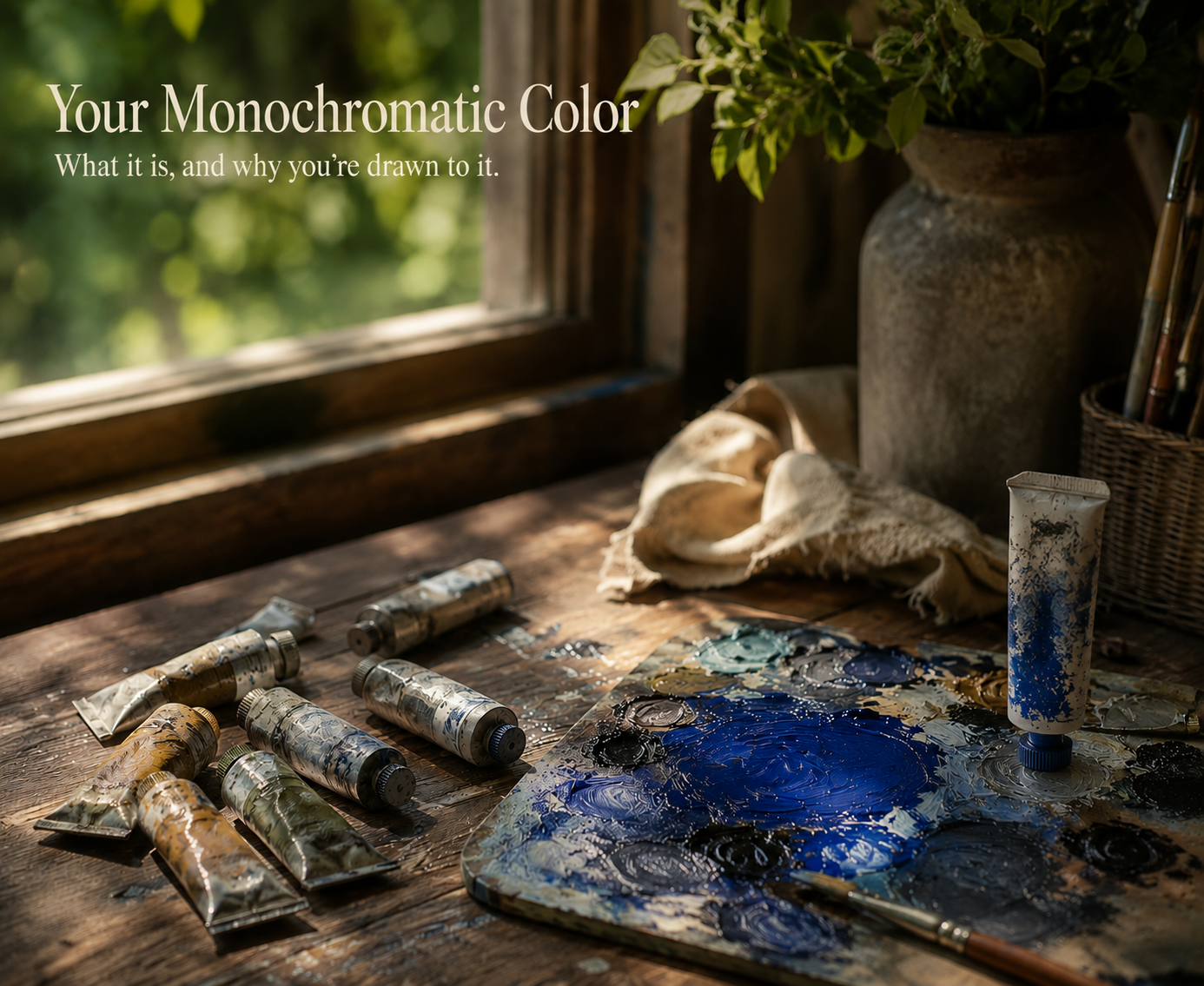
Have you ever noticed you keep choosing the same color, over and over, without really deciding to? It shows up in your wardrobe. Your bedroom walls. The car you picked. The flowers you stop to look at. You didn't plan it, it just kept happening.
That's your monochromatic color. And it might be saying more than you realize.
What "Monochromatic" Actually Means
In art, monochromatic simply means built around one color, different shades, tints, and tones of a single hue, rather than a mix of many. A monochromatic painting might use ten different values of blue, from almost white to nearly black, and nothing else.
But the idea goes beyond canvas. Most people have a personal monochromatic color too, one shade they keep gravitating toward across completely unrelated parts of their life, almost without noticing.
Every Color Carries a Meaning — But Not Always the Same One
Color psychology tells us certain shades tend to carry shared associations, blue is often linked to calm or melancholy, red to passion or urgency, yellow to warmth or optimism. These associations show up again and again across cultures and history, which is part of why color is such a powerful tool in art.
Take Pablo Picasso's Blue Period, from 1901 to 1904. After the death of a close friend, Picasso painted almost exclusively in shades of blue and blue-green, gaunt figures, somber scenes, a mood of grief and isolation carried entirely through one color family. For Picasso, blue wasn't just a preference. It was the only color that could hold what he was feeling.
But here's the part that makes this personal, not just historical: the same color can mean something completely different to two different people.
What Does Your Color Mean to You?
For me, dark blue isn't sadness. It's the color of someone's eyes — someone I love. The same shade Picasso used to paint grief is, for me, tied to warmth, to home, to a person I look forward to seeing.
That's the real truth about color: it has shared meanings, but it also has yours. Your monochromatic color might trace back to a childhood bedroom, a person, a place, a memory you haven't thought about in years — something your mind quietly attached to that shade long before you consciously noticed the pattern.
Have you ever stopped to ask yourself why you love the color you love? Not what it's "supposed" to mean — what it actually means to you.
Try This Today
Think about the color you keep choosing without meaning to. The one on your walls, your favorite shirt, the pen you always pick up first. Sit with it for a minute, and ask: where does this feeling come from? You might be surprised what you remember.
That personal connection, the reason a color feels like yours, is exactly what makes painting with intention so powerful. When you choose color based on what it means to you, not just what "looks right," your work stops being decoration and starts being personal.
Discover What Color Means to You
In my 13-day course, you'll learn real color theory , not just the shared meanings, but how to use color to express what's personal and true to you. Every painting becomes a little more yours.
✨ Begin Your 13-Day Art Healing Journey Here 🎨
Until next time... please keep creating.
#Tags: #ColorTheory #ColorPsychology #Monochromatic #ModernArt #ArtEducation #Picasso #ArtTherapy #OutlinesSoul #CreativeExpression
Share:
Pour Your Emotion Here: The Truth About the Blank Canvas
You Don't Have to Leave the House to Feel Alive Again